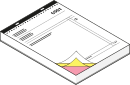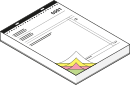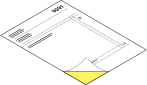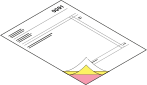
If you’ve ever ordered NCR Pads, NCR Books or NCR Sets, you’ve probably come across the terms CB, CFB and CF. While these abbreviations may seem confusing at first, they simply describe the different layers of carbonless paper and how they work together to create duplicate copies.
In this guide, we’ll explain what CB, CFB and CF NCR paper mean, how each sheet works and why they’re used in NCR printing.
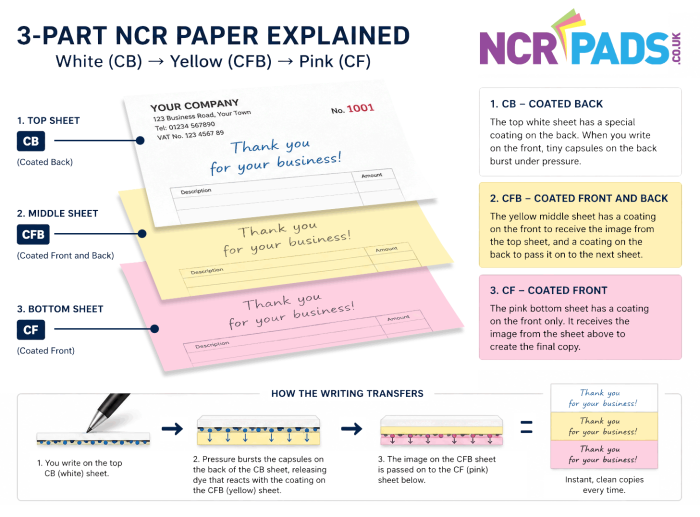
The three abbreviations refer to the coating applied to each sheet of carbonless paper.
Each sheet has a specific purpose, allowing the writing on the top page to transfer cleanly onto the sheets below without using traditional carbon paper.
Carbonless paper contains microscopic capsules and reactive coatings.
When pressure is applied with a pen or impact printer, the tiny capsules on the back of the top sheet burst, releasing a colourless dye. This reacts with the coating on the front of the sheet beneath, instantly producing an identical copy.
The process happens automatically as you write, with no separate carbon sheet required.
CB (Coated Back) paper is always the top sheet in an NCR set.
It has a normal writing surface on the front, while the back is coated with microscopic capsules containing a colourless dye.
When you write on the front of the CB sheet, pressure causes the capsules on the reverse to burst, transferring the writing onto the sheet below.
CFB (Coated Front and Back) paper is used as the middle sheet in multi-part NCR forms.
It has:
This means it performs two jobs:
If four or five-part NCR forms are required, additional CFB sheets are added.
CF (Coated Front) paper is always the final sheet in the set.
Unlike the other sheets, it only has a receiving coating on the front and no coating on the back.
Its job is simply to receive the final copy of the writing.
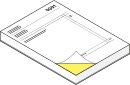
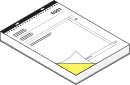
A standard 2-part NCR pad consists of:
| Sheet | Type |
|---|---|
| Top | CB |
| Bottom | CF |
When you write on the top CB sheet, the information is automatically transferred to the CF sheet below.
Because there is only one copy, a CFB sheet isn’t required.
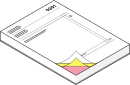
A standard 3-part NCR pad consists of:
| Sheet | Type |
|---|---|
| Top | CB |
| Middle | CFB |
| Bottom | CF |
When you write on the top CB sheet, the information is automatically transferred to both the CFB sheet and the CF sheet, creating two identical copies.
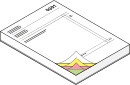
A standard 4-part NCR pad consists of:
| Sheet | Type |
|---|---|
| Top | CB |
| Second | CFB |
| Third | CFB |
| Bottom | CF |
When you write on the top CB sheet, the information is automatically transferred through each CFB sheet before reaching the final CF sheet, creating three identical copies.
Carbonless NCR paper is available in a range of colours, allowing you to easily identify each copy within a set or match your own filing system.
Standard NCR paper colours include:
The paper colours themselves do not affect how the NCR paper works, they simply make it easier to distinguish between the different copies.
If you require a specific colour that isn’t available as a standard carbonless paper, we can often achieve the desired appearance by printing a 100% colour wash onto a white sheet, providing greater flexibility while retaining all the benefits of carbonless paper.
In most cases, yes.
On sheet-fed printing presses, all parts are typically produced using 75gsm or 80gsm carbonless paper, so the only difference between the sheets is the coating applied to each one.
However, reel-fed (web-fed) printing presses use a mixture of paper weights, such as 80gsm / 60gsm / 57gsm and 53gsm. This helps improve handling and performance during high-speed production.
Regardless of the paper weight used, each sheet is specifically designed to work together to produce clear, legible copies throughout the NCR set.
Yes, all sheets can be professionally printed with your logo, company details, terms and conditions, numbering and other information.
Yes, sequential numbering is one of the most popular options for NCR pads, books and sets.
Yes, NCR paper is available in a range of colours, allowing different copies to be easily identified. The paper colours can usually be arranged in the order that best suits your business requirements.
CB stands for Coated Back, CFB stands for Coated Front and Back and CF stands for Coated Front. These coatings allow pressure applied to the top sheet to transfer writing through the NCR set without the need for traditional carbon paper.
Whether you require 2-part, 3-part or 4-part NCR pads, books or loose sets, we’re here to help.
If you’re unsure which paper combination is right for your application, get in touch with our friendly team. We’ll be happy to recommend the best option for your business and answer any questions you may have.